I did my first pitch at the age of 22 during my final college year in 2014. In 6 months, we found an investor. Three years after that, we shut down our project. And now, a decade later, I found myself doing it all over again. Pitching is a strange game—equal parts confidence, clarity, and survival. Over the years, I’ve seen and made every mistake possible. Let’s break down WHY MOST PITCHES fail.
1. Overusing Buzzwords
“We’re revolutionising the industry!”
“It’s the OpenAI of X!”
“We empower stakeholders to drive synergies and unlock value!”
Stop. Just stop. Overloading a pitch with buzzwords makes it sound hollow. Investors have heard every version of “next-gen, innovative, game-changing” before. The more you rely on vague, overused terms, the less you seem to understand your own business.
Why it won’t work: People trust specificity. When pitches are filled with generic hype, the brain categorises them as marketing fluff rather than substance. It’s why saying, “We help small retailers increase repeat purchases by 40% through AI-powered inventory forecasting,” is 100x better than “We disrupt retail with AI.”
2. Focusing More on Idea Than Execution
The idea itself isn’t the hard part—execution is. Every investor knows that ideas are cheap. If your pitch spends more time on “why this is a great idea” instead of “how we’re actually making it happen,” you’ve already lost them.
Why it won’t work: A great pitch isn’t about why the problem exists; it’s about why you are the best person to solve it. The execution plan, traction, and market insights separate a winning pitch from wishful thinking.
3. Vagueness
If a founder can’t answer basic questions—“Who is your target audience? How will you acquire customers? How will you make money?”—it’s over. Investors don’t fund question marks.
The Science of Persuasion: People buy (or invest) in what they understand. If you can’t explain your business in one clear sentence, you don’t understand it well enough.
4. Over-Promising or Forcing AI into Everything
“We’re going to change the world!”
“Our AI-powered toothbrush will disrupt the dental industry!”
Not everything needs AI. If your business can’t survive without adding trendy tech for the sake of it, then it’s not a real business—it’s a gimmick.
Why it won’t work: People are skeptical of exaggerated claims. The more you promise, the higher the mental resistance. Investors and customers both respond better to grounded, achievable milestones.
5. Dodging Tough Questions
Nothing screams “I haven’t thought this through” like avoiding a tough question. Investors will challenge your numbers, your strategy, and your risks. If you dodge, deflect, or get defensive, they know you’re not prepared.
Psychology of Confidence: The best founders don’t bluff. They acknowledge weaknesses but show they have a plan. Transparency builds trust; avoidance kills it.
6. No Social Proof or Testimonials
“Do you have examples of past work?”
“Sorry, it’s all confidential.”
🚩🚩🚩
If you can’t show results—case studies, testimonials, pilot runs—why should anyone believe you? Whether it’s an investor or a potential client, people need proof that what you say isn’t just theory.
Consumer Trust Principle: Humans rely on social proof to make decisions. That’s why reviews and case studies convert. If you can’t provide proof, people assume the worst.
7. Acting Like a “Founder Persona” Instead of a Real Person
Rehearsed, robotic, over-the-top confidence? Investors see through it.
The best pitches are conversations. If you believe in what you’re building and have real traction, you don’t need to “perform.” Just be real, know your numbers, and explain your business like you’re talking to a smart friend.
How to Fix Your Pitch
Cut the buzzwords—be specific.
Talk about execution, not just the idea.
Answer questions with clarity, not fluff.
Don’t force AI or trends where they don’t belong.
Show proof. Numbers, testimonials, traction.
Be a person. Have a conversation.
The best founders don’t sell a dream; they sell a plan. And the best investors don’t fund hype; they fund execution.So next time you pitch, ask yourself: Is this real, or is this just noise.
Starting your first or a new job can feel like stepping into a dense forest. You expect a peaceful, structured environment, but instead, you find workplace stress creeping in from all directions. The unpredictability, lack of clear tasks, and constant pressure to perform can quickly turn into work-related stress. Instead of step-by-step guidance, you’re handed vague instructions and overloaded with expectations—making stress at work feel inevitable.
Without proper training or clear direction, the pressure builds up, leading to workplace burnout. You try to keep up, but when expectations aren’t aligned with reality, dealing with stress at work becomes a daily struggle. So, why does this happen? More importantly, what are the best strategies for managing stress in the workplace when you feel lost?
The Reality of Unstructured Workplaces
Most companies don’t have a clear process for onboarding fresh graduates. They assume you’ll “figure it out” because, in their minds, the job is already running. Managers are busy handling their own responsibilities and don’t always have the time (or patience) to train you properly. Instead of structured learning, you get bits and pieces of information and are expected to connect the dots yourself.
Why Companies Expect You to ‘Figure It Out’
There’s an assumption in many workplaces that learning happens by doing. Instead of training, they give you tasks and expect you to learn as you go. This can work for some, but without a clear foundation, it often leads to mistakes, frustration, and imposter syndrome. If a company lacks a structured marketing strategy or defined workflows, you’re not just learning your role—you’re building it from scratch.
Turning Workplace Disorder into a Learning Opportunity
A messy workplace can be seen as a hell in a cell or a free MBA—you decide. It’s a common question: how are you dealing with burnout at work? My simple answer is: when things are chaotic, start by documenting everything. No marketing assets? Make a shared drive and collect what you can. No clear strategy? Observe patterns, take notes, and connect the dots yourself. If no one’s giving you answers, become the person who finds them. That’s how you gain control in an uncontrollable system.
When a company lacks structure, it’s secretly an invitation to experiment. If no one is following a process, create one. If goals are vague, suggest a clear direction. If the workplace environment is causing stress and burnout in the workplace, set healthy boundaries. No one will stop you. Why? Because most people are too busy to fix things. If you take initiative, they’ll assume you know what you’re doing—and before you know it, you actually will.
Strategic Thinking: Creating Value in a Messy Environment
Most workplaces don’t need more effort; they need better thinking. Instead of just coping with stress at work or complaining about the lack of direction, ask: What’s the real problem here? Are campaigns failing because there’s no targeting? Are leads bad because sales and marketing aren’t aligned? Find the root cause, not just the symptoms. Strategy is just structured common sense.
Also, document your findings. When you spot inefficiencies, don’t just talk about them—write them down, suggest solutions, and track improvements. The moment you start thinking like a problem-solver, people stop treating you like a clueless newbie. And once you bring structure into chaos, you become valuable. That’s how you win in a disorganised workplace.
Staying or Leaving: A Decision Based on Rational Analysis
Quitting feels tempting, but before you make a dramatic exit, ask: Am I learning something useful? If the job is chaotic but teaches you resourcefulness, problem-solving, or industry insights, it’s worth staying a little longer. Not all bad jobs are useless—some are just tough teachers.
But if you’re stuck in a loop of confusion, doing work that doesn’t build your skills, then yes, start job hunting. Make a practical transition plan: update your resume, apply quietly, and leave on your terms, not out of frustration. Jumping ship without a plan isn’t brave—it’s reckless.
Making an Impact While Preparing for What’s Next
Even if you’re planning to leave, don’t check out mentally. Every task is a chance to build skills, improve your resume, or create something that proves your value. Find small wins. Organise the marketing mess, create a simple campaign report, or optimise a process. Future employers love tangible impact, not just “I worked there” on your CV.
Also, start networking yesterday. Talk to people in your field, join industry groups, and engage on LinkedIn. Jobs don’t magically appear; they come from people. If you quietly build skills and connections while stuck in a messy job, you won’t just escape—you’ll upgrade.
The Hidden Truth: It’s Not Just You
Many companies, especially small or midsized ones, are still figuring out their own marketing approach. They don’t have well-defined goals, target audiences, or structured campaigns. This means even senior employees are improvising. You’re not failing—the system itself is messy.
The key is recognising this early. Instead of waiting for clarity, start documenting what’s missing. What information do you need to do your job well? What patterns do you see in the confusion? If you can map out the gaps, you’ll be in a better position to either fix them or use them as leverage when discussing your role.
Have you ever wondered about those moments when you wish for something—a sea breeze, perhaps—and suddenly, your friend calls for a beach walk? It feels like there’s an unseen force listening to your thoughts, understanding your wishes, and weaving them into reality. I call it as hidden blessings, some says it’s the Atma of your dearest ones, maybe your grandma, maybe your childhood friend who died in an accident. Whatever it might be, I strongly believe there is a mysterious or hidden aura around us, that quietly orchestrates the events for us. It’s listening you, and seeking you.
Ghostly reflection experiment
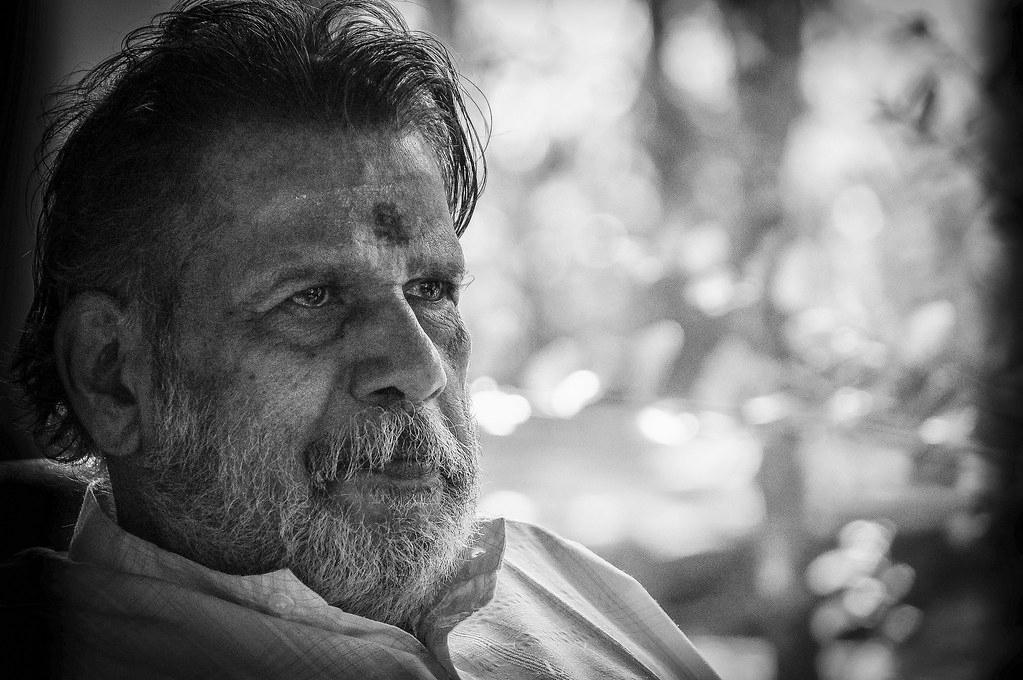
Madampu Kunjukuttan
Recently, I came across a memoir by Madampu Kunjukuttan that reminded me of this thought. Those who don’t know Madampu should try the biographical novel Bhrashtu. It’s the real life story of an 18th century Namboodiri woman excommunicated for adultery — during the court hearing, she shocked the presiding court by naming a score of society notables whom she encountered, it’s a revenge-bound story which exfoliate the hypocratic patriarchal community of 18th century Kerala.
Madampu Kunjukuttan (1941- 2021)
Madampu Kunjukuttan used to frequently visit Mookambika temple between Kollur and Kodachadri during his early writing days. Those trips helped him to introspect and infuse a spiritual enlightenment in Madampu, both as a writer and a spiritual seeker.
Those who have read Aaryavartham or Bhrashtu can connect with my words. From Adikula nathan’s disintegration, Aryavartam is the story of the Adigotras, who emerge as four clans. The sub-plots in an extended narrative style are enough to understand the depth of Madampu’s thought processes.
A Yogi, Madampu & Their Karmic Interconnectedness
During one such Mookambika visit, he encountered a young yogi deeply immersed in meditation at Sarvagnya Peetha. Intrigued by the yogi’s serene demeanour, Madampu approached him and kept three coins there as a Bhiksha (noble donation). Madampu turned back and took a few steps, but suddenly the yogi opened his eyes and called him back.
Kodachadri Hills
With polished British English, the yogi calmly asked, ‘What brings you here with these coins?’
‘I do not know; it just felt right,’ Madampu replied with a smile.
‘Will it always feel right?’ The yogi chuckled, prompting Madampu to respond in his own way, ‘Probably not.’
The yogi grasped Madampu’s hand. ‘Brother, today I thought of this: someone donating 3 coins. In a week’s time, I will go to the valley and buy three handfuls of rice with three coins. That’s enough for me for a week. This money you brought here will fulfil my needs for the week. The grace of my guru.’
The yogi then shared his story. He spoke of spiritual journeys and learnings—of Himalayan expeditions, encounters with Shankaracharya’s teachings, and seeking the essence of Devi worship. He recounted his time studying Sanskrit under Jnanananda Saraswati in Rishikesh.
Then, with those sparkling eyes, Yogi asked, Have you ever heard about my guru, Jnanananda Saraswati?
This question from Yogi, who was a foreigner in Kodachadri, took Madamb back to his childhood. A period even before Madambu’s Upanayana.
Once, during a monsoon afternoon, Madampu and his brothers saw someone at the doorstep. The man was conversing with elders, and Madampu discovered that he was a man from the south, well-versed in Puranas and Sanskrit. Madampu asked his uncle, ‘Who is this?’ ‘Parameshwaran,’ came the reply.
That was the first time he met that genius.
‘I need to eat,’ Parameswaran said. ‘Clean yourself at the pool, and the food will be ready,’ Madampu’s uncle replied. The family gave him food and shelter. That’s how Parameshwaran lived in Madampu’s Mana for five years! He also taught Sanskrit to Madampu and his siblings.
Parameswaran Unnithan started teaching sanskrit to many children in his area, and finally he married the sibling of one of his disciples. His children went abroad, received a good education, and began a successful career there.
Parameshwaran Unnithan, who had travelled from Kerala to the Himalayas, influenced by Adi Shankara and Brahmasutrabhasya, in search of knowledge, reached Rishikesh, then obtained Deeksha and became Jnanananda Saraswati. The same Parameswaran Unnithan who taught Madampu Sanskrit is the one who taught that young yogi Sanskrit.
“Do you know Malayali Gnananda Saraswathi?”
Young Yogi asked again.
Yogi’s question awakened Madambu from his past. A misty breeze that came from beyond the mountains in Kodachadri caressed both of them.
“I know. He has also taught me Sanskrit. He stayed with us for four to five years. We got his blessings.”
Young Yogi’s eyes were filled with tears after listening to this.
“Everything happens for a reason, “Yogi said.
Madampu remembered Yogi’s words. When he got three rupees, the young British yogi said that it was the blessing of the Guru. The sky stood red above Sarvagnya Peetha; it made them feel like Mookambika Devi was showering Vermillion with her blessings.
Philosophies Around Interconnectedness
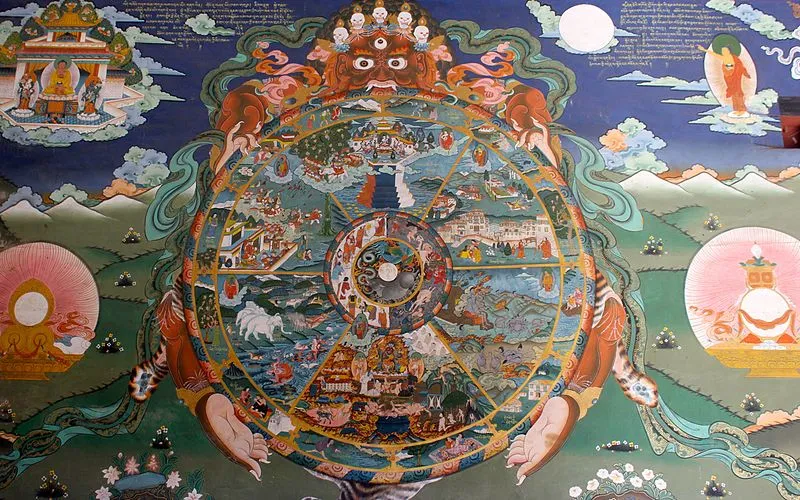
This interconnectedness and hidden auras which are working for us, can be seen in many philosphies. In Eastern philosphies, it’s called Karma and Dharma. It suggest that our actions and thoughts have ripple effects beyond what we perceive. In Buddhism, for example, posits that all beings are interconnected, and actions (karma) influence future outcomes in a complex web of cause and effect.
Modern philosphies describe it as Butterfly effect. This chaos theory illustrates how small changes can lead to significant consequences over time. It suggests that even tiny, seemingly insignificant actions or events can have far-reaching effects in complex systems.
The most modern word is manifestation; it refers to the belief that through focused thoughts, intentions, and actions, individuals can attract or create desired outcomes in their lives. Recently, in an interview, actor Vijay Sethupathy said he manifested his acting career. I believe the aura around him might have listened and worked for him.
Imagine this: hidden energies or unseen and mysterious Atmas, surrounding us ceaselessly, attentive to our every whisper and thought. They are like silent guardians, fulfilling the commands of our subconscious minds.
When our intentions are noble, these energies conspire to nurture and elevate us, crafting pathways to our desires. When our thoughts are evil headed, their influence can be ominous, steering us towards destruction.
What do you think? Are we mere vessels, or do we wield unseen powers that shape our destinies? Do you believe in this interconnectedness? Have you ever experienced these mysterious aura around you working for your wishes. Share in comments.
The saga of the Pandava brothers and Draupadi, their final journey to heaven, unfolds the curtain of sin, love, compassion, and unwavering adherence to Dharma.Here we are looking at why the righteous Pandavas suffered.
The Pandavas anointed Parikshit as the crown prince of Hastinapura. They appointed Yuyutsu as the guardian of the young prince. Yuyutsu, born to Dhritarashtra and a Shudra woman, was a beloved figure among the Pandava brothers. He had shown courage to stand with them on the path of Dharma and was considered a son-like to them.
From Hastinapura, Pandava brothers and Draupadi set out walking in the northern direction. In one word, ‘Vanaprastham’
Pandava’s Maha Vanaprastham
Draupadi: The First Loss
On their journey, the first to surrender to mortality was Draupadi. Bhima saw this first, and he couldn’t bear that. His love for Draupadi was profound; he was the one who loved her most.
He fiercely avenged her dishonour in the Kaurava court with blood. During their exile in the forest, Bhima diligently ensures Draupadi’s safety and comfort. How could we forget the Kichaka chapterfrom Mahabharatha? Even when Arjuna was hesitant, Bhima prioritised Draupadi. Even Bhima encountered Hanuman to fulfil Draupadi’s desire for a flower.
Bhim washing Draupadi’s hair with blood (Image credit: insta/saptasarka)
Bhima collapsed, seeing Draupadi lying motionless on the earth. But the Pandava brothers knew they had to keep going. When others were walking, Bhima asked Yudhishthira, the wisest among all, ‘Why did Draupadi die? She did nothing wrong.’
Yudhishthira said, ‘Our journey is about more than just living and dying. We shouldn’t think too much about it. Draupadi was good, but she was only meant to come with us until here.’ Bhima said, ‘But she was our wife! She should always be with us!’ Yudhishthira calmly said, ‘It’s not up to us. What happened to Draupadi was because of what she did in her life.
Draupadi: Where Love meets Sin
Draupadi loved all five of us, but deep in her heart, she had a special place for Arjuna, the first one to win her heart. This natural inclination of her heart highlights the nuanced psychology of love and attachment in women. A woman, even if she is with many men, can deeply love only one. Maybe he was her first love, or maybe he was the one who made her wet for the first time or who offered her a shoulder in her darkest hours.
Yudishitra, Wisest among the Pandava Brothers
Draupadi with Pandava brothers (Image credit: Hotstar)
Bhima, Draupad’s sin was her lust towards Arjuna, but remember, she was noble and righteous, and that’s why she could travel with us this far. I understand your deep feelings for her. You have always protected her. Only Arjuna could truly win her heart, beyond her physical being. And for the four of us who came after, she never denied us fairness and love. She never showed dislike or boredom for our sake. Draupadi was like a goddess! let’s move on, Bhima.’
The Downfall of Sahadeva, Nakula, and Arjuna
During their ongoing journey, Sahadeva was the next to die, followed by Nakula. Yudhishthira explained to Bhima that Sahadeva’s pride in his wisdom and Nakula’s pride in his beauty were their downfalls.
Then, it was Arjuna’s turn. He also surrendered to Yama, the god of death. Bhima again asked Yudhishthira why. Yudhishthira said, ‘Arjuna once vowed to defeat all enemies by himself. This boastfulness and wrath, along with his envy, were his sins. That’s why he couldn’t continue the journey.‘ Then they continued walking
Losses Along the Way: Fall of a Gentle Giant
When Bhima was about to fall, he asked Yudhishthira, ‘Elder brother, I am about to fall. What’s my fault?’ Yudhishthira replied, ‘Bhima, you are dear to me. But your pride in your strength and your love for food (gluttony) were your downfalls.‘ Yudhishthira continued his journey alone, as his brothers’ deaths did not stop him.
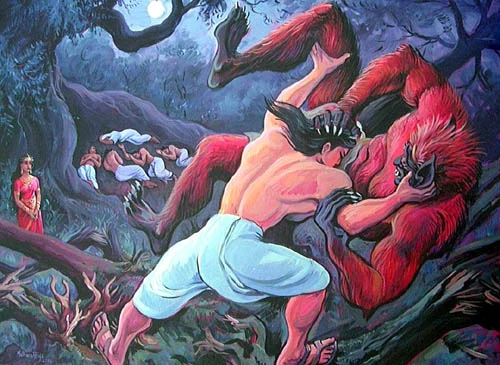
Bhima Fighting against Asur
At Heaven’s Gate: Righteous Among Pandavas
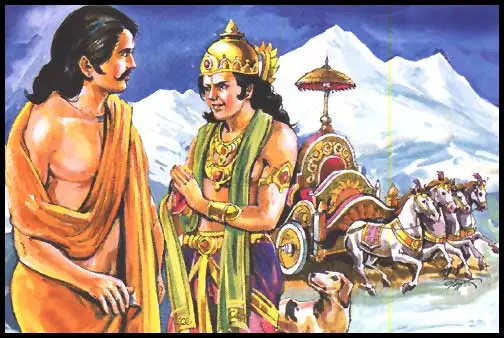
From the day they left Hastinapura, a dog had been following the Pandavas. Even as others fell during the long journey, the dog stayed with Yudhishthira. When Yudhishthira reached his destination, the gates of heaven were ready to welcome him. Indra arrived in his chariot and said to Yudhishthira, ‘Climb into the chariot! There is no one in heaven more worthy than you to join us. Don’t hesitate, Yudhishthira, come with me!
Yudishtira and Indra
Yudhishthira told Indra, ‘I’m not completely happy with this blessing you’ve given me.’‘What? You don’t want to go to heaven?’ asked Indra. Yudhishthira replied, ‘No, Lord! The Pandavas and Draupadi started this journey together. They all died on the way, and I don’t even know what happened to them. Going to heaven alone will bring me more pain than joy. My brothers are my life, and Draupadi is part of our soul. Please tell me where they are now.’Indra smiled and said, ‘Yudhishthira, the world has never seen a brother as loving as you. You often seemed weak because of your love for your family. Is this really commendable? Is it that hard to let go?‘ Yudhishthira, with a lifeless smile, replied, ‘A person without love for his dependents doesn’t deserve to live on earth. My love for my brothers and Draupadi is beyond my senses. Please help me!
Indra told Yudhishthira, ‘Your brothers and Draupadi were good people. They have already reached heaven after leaving their bodies behind. But they did not have the greatness you have, so you are allowed to enter heaven while still alive. Climb into the chariot. You can trust my words.’ Yudhishthira responded, ‘I have one more request.’ Indra looked at Yudhishthira sceptically.
Yudhishthira’s Conflict of Heart and Duty
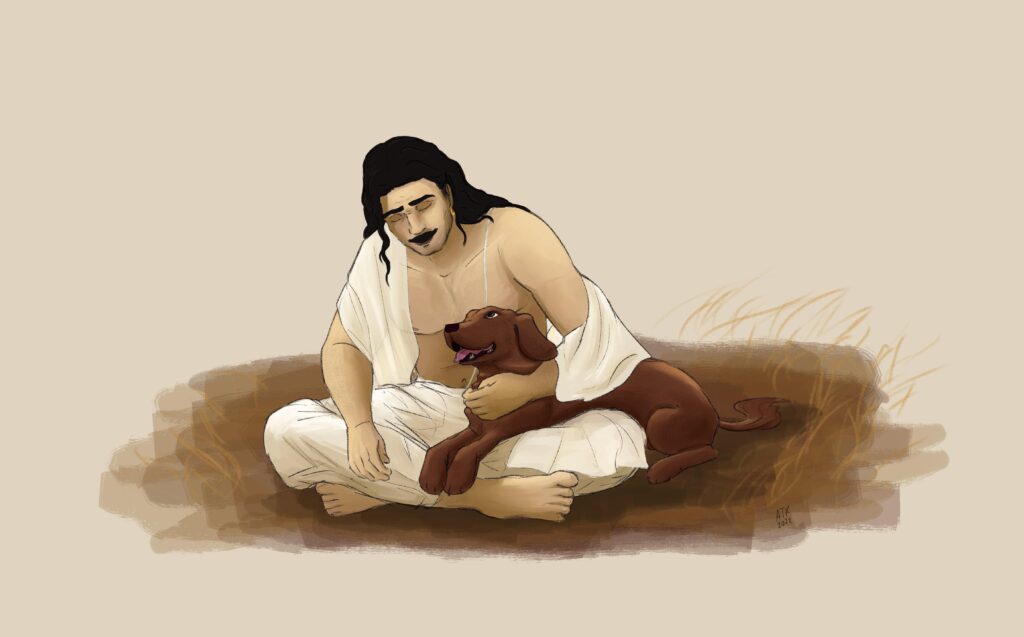
Yudhishthira said, ‘I cannot abandon this dog that has been with me until the end of my journey. Please let it come with me on the chariot.’ Indra laughed a little and said, ‘You know that dogs cannot enter heaven. Yet, you insist on this worthless animal.’
‘No! Lord Indra, go ahead without me. This dog will always be with me. If I leave this dog behind, all my good deeds for heaven will be worthless. I will never abandon those who depend on me!’
Indra said, ‘You left your brothers and Draupadi on the way. Do you care more for this insignificant dog?’ Yudhishthira replied, ‘My brothers and Draupadi died along the way, and I couldn’t bring them back to life. But this poor animal is still alive and has been with me through this long journey. I cannot abandon it.’ As Indra looked at Yudhishthira with compassion, the dog transformed. It was Dharma Deva, the god of death, who had followed him in the form of a dog. He said, ‘Son, your compassion has filled me with pride. You have passed a test beyond ordinary trials. The world will praise you as Yudhishthira, a name synonymous with dharma. Your words and actions have always been rooted in righteousness, and you have never strayed from this path. Go with Indra.’
Yudhishthira boarded Indra’s chariot, and they soared through the sky, eventually reaching heaven.
The Celestial Reunion of Pandavas
He entered heaven and saw Krishna sitting on a majestic throne, with Arjuna beside him. They stood up and joyfully welcomed Yudhishthira. He found Karna among the twelve Adityas and bowed to him. Karna smiled and welcomed his brother. Bhima was among the Maruts, Nakula and Sahadeva were near the Ashwini Kumaras, and they all greeted Yudhishthira with respect. Draupadi, shining like a bright star, was there with their five sons. They all bowed to Yudhishthira. He saw Drona blessed by Brihaspati and Bhishma seated among the Vasus, to whom he bowed. Duryodhana, smiling on a special throne, stood up to honour Yudhishthira. In heaven, there is no enmity. Duryodhana, having died a heroic death and fulfilled his duties well, had earned a special place in heaven. (Even Yudishtira did a minor sin and he faced some challenges at Heaven, but we skipped that part since it’s too long for this)
Beyond Myths: Love, Loss, and Life’s Eternal Lessons
The reunion with his brothers, Draupadi and Duryodhana, each radiant in their own right, symbolised the eternal cycle of life, death, and redemption. So, this story might be more than just a myth because it reveals a timeless truth: Draupadi’s quiet love for Arjuna, even as Bhima loves her deeply, shows us how complex our hearts can be. It tells us that even wise and strong people like Yudhishthira struggle with letting go of those they love. Finally, it tells us that, in the heart of forgiveness and empathy, lies the true path to liberation, the Moksha.
What’s the secret of happiness? Let’s learn from Mitchell Marsh and his super cool World Cup celebration.
If I were to choose a single image that encapsulates the essence of this World Cup, my finger would point unhesitatingly to this particular scene. It’s the picture of the young Mitchell Marsh, his foot triumphantly planted atop the World Cup trophy. The fact that it was Pat Cummins who shared this moment with the world is far from coincidental 😉
Mitchell Marsh with the World Cup trophy
For many, it might be arrogance or direspect, but in my perspective, Mitchell brought a philosophy echoing the very thoughts and actions of Buddha himself. This philosophy, known in English as ‘Detachment’, embodies ideas of dispassion, disillusionment, and liberation from entanglements. The epitome of this concept, in its most tangible form, was achieved by Buddha in the name of Nirvana & Hindu saints and Jaina aints in the name of ‘Moksha‘.
The Zen of Victory: Mitchell Marsh’s World Cup Philosophy
Osho Rajneesh, Ramana Maharshi, and various Jain saints have extensively spoken about this philosophy. However, Mitchell Marsh, through a single act, illuminated this principle in its most tangible form. Every achievement, whether it’s winning the World Cup or an election victory, is transient.
The essence here is the concept of detachment and the transient nature of events and achievements. Mitchell Marsh’s act is a powerful embodiment of this, showcasing that even significant victories like the World Cup are just fleeting moments in the grand scheme of life. I remember a Zen Buddhist story that may connect this better.
The Tale of Two Monks: A Lesson in Non-Attachment
Two monks, one older and one younger, are travelling together. At one point, they come to a river with a strong current. As they prepare to cross, they meet a young woman who is unable to cross by herself. The older monk offers to carry her across on his back, and she gratefully accepts. After he safely delivers her to the other side, they part ways.
Image from a textbook
After some time, the younger monk questions the elder: ‘Was it right for you to carry that young woman on your shoulders?‘ To this, The older monk replies, “I put her down on the other side of the river. Why are you still carrying her?”.
Cultural Misinterpretations: Respect vs. Detachment
On Sunday, Mitchell Marsh was in the role of this older monk. By declaring the World Cup trophy merely a cup after the victory, he precisely and subtly communicated to us the impermanence of both triumph and defeat. It’s a profound lesson in how fleeting both success and failure are.
Image of Mitchell Marsh shared by cybersanskaris
There are those who criticise this scene. They see placing a foot on the World Cup as disrespectful. These are the same people who do not hesitate to remain silent in the face of blatant injustices. They forget that respect is a feudal value, heavily overshadowed by hierarchy. In their view, certain actions, even symbolic, are unacceptable breaches of decorum, ignoring the deeper symbolic messages such actions might convey.
Practising Detachment: Insights from Mitchell Marsh
You might be thinking that this sounds like actor Vijay fans decoding the brilliance behind the popular Tamil movie Leo. Let me tell you, the base of this interpretation is an interview from Mitchell Marsh.
Mitchell Marsh Interview
In it, Mitchell mentions that he has been training with a psychologist to navigate life, focusing on how to become detached from outcomes. ‘Detachment’ is the key concept Mitchell emphasises. This concept echoes Lord Krishna’s teachings in the Bhagavad Gita about acting without attachment to the results. I cannot recall another recent instance where the profound teachings of Buddha or lord Krsihna have been so effectively put into practise.
Feudal Mindset & The Philosophy of Detachment
Our leaders, superstars, and celebrities should all take a leaf out of Mitchell’s book. His approach is a guiding finger to those who revel in the shadows of egoism. Let’s take a closer look at Kerala.
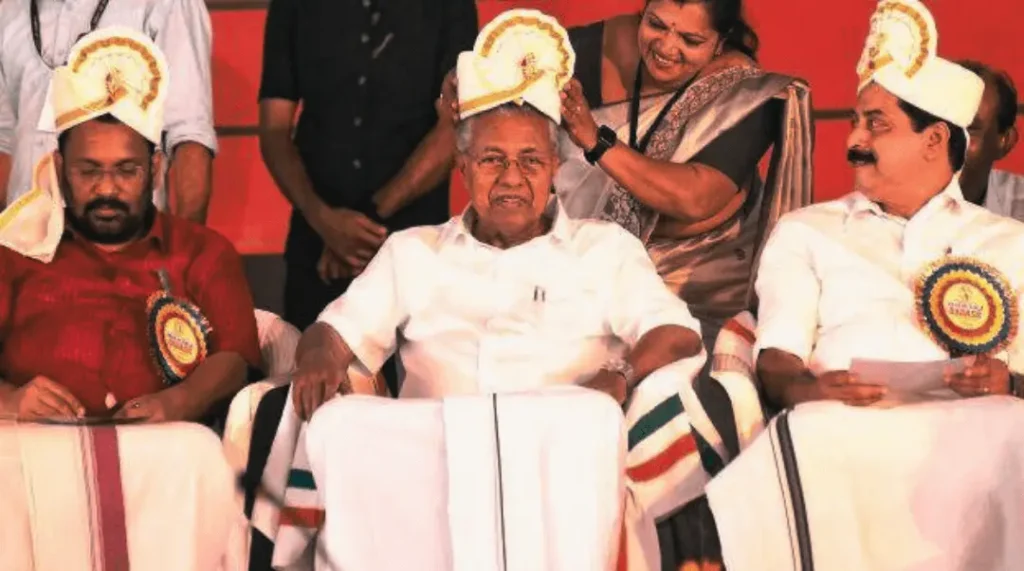
Kerala Chief Minister in a public outreach programme
Look at our hon.PM Narendra Modi, If he goes to great lengths to maintain his power, it’s not surprising. He has been in power since 2000, and detachment from such a long-held position is no easy feat.
Reflecting on ourselves, can we detach from our past, from our achievements? If it were a yes, we wouldn’t have celebrated Arjun Reddy or Kabir Singh, and we wouldn’t have played so many Lofi songs. Letting Go is a skill that we all should gain.
Most of us bask in the glory of our past successes or failures, but true happiness and growth lie in moving on. Growth happens when you let go. This is especially relevant in a society where maintaining status and power often becomes an end in itself. If we can learn to detach, to let go of these attachments, we can find not just individual contentment but also create a more balanced and equitable society.
Live Love Learn Liberate
Detachment: Here lies the secret of happiness. As I always say: Live to Love, Love to Learn, Learn to Liberate. This mission makes your life content.